









Optimising Predictive Maintenance Management for Airlines
Enea Fracassi, Chief Operating Officer, Corsair International
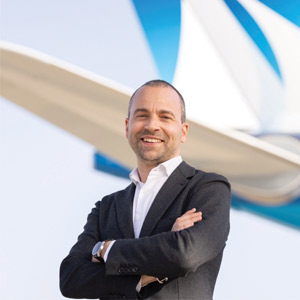
Enea Fracassi, Chief Operating Officer, Corsair International
Enea Fracassi, the Chief Operating Officer of Corsair International plays a significant role in managing the enterprise performance in a very capital-intensive industry and high competition sectors. His 20 years’ of experience as General manager in the aviation sector has contributed immensely to his understanding of the entire value chain of air travel.
As the chief operating officer, what are the different kinds of challenges that you see in the aviation space today?There are two main challenges in the aviation industry; the environmental challenges that existed before the pandemic, like the noise and air pollution caused by aeroplanes’ engines, and the more recent operational challenges resulting from the COVID-19 crisis. The COVID-19 pandemic reinstated the importance of the aviation sector in global mobilisation. Although travel rates suffered a huge blow, we continued running our business as usual to respond to the circumstantial as well as the environmental challenges by improving our operations and modernising our fleets. For instance, we started a fleet renewal initiative that replaced conventional operational procedures with more green practices.
Another way we responded to the environmental challenge was by equipping our aircraft with new technologies to achieve fuel economy. The newer approaches can bring almost 25 percent improvement in fuel consumption, if not more. Better fuel consumption, in turn, can result in fewer emissions than the previous generation of aircraft and cause less noise pollution. Sustainable aviation fuel, however, can be 4 to 5 times more expensive than traditional fuels.
Data analytics, on the other hand, is a solid response to the operational challenges, along with the environmental issues, because the more we optimise how we manage our aircraft fleet operations and the lesser we consume fuel, the smarter we manoeuvre our services despite global crises.
Embracing these projects is not as easy as it sounds. Besides financial constraints, there’s heavy change management involved in reaching the goal. That doesn’t mean we should not strive towards it; innovative planning is the key to making it happen smoothly and efficiently.
From a technical point of view, we aim to improve our performance with the help of predictive maintenance, with trends like big data and artificial intelligence (ai)
From a technical point of view, we aim to improve our performance with the help of predictive maintenance, by riding on the bandwagon of big data and artificial intelligence (AI). As a result, we have implemented Skywise, a platform developed by Airbus and Palantir. It uses predictive maintenance to improve how we operate and manage our fleet and save maintenance costs, all while increasing passenger safety. The platform is also able to foresee a tentative timeline of a failure, prompting us to take action and fix that part immediately. That is key to achieving an extremely high level of dispatch reliability. Another trend we have financed and implemented is the airport certified employee (ACE) research to push our aircraft utilisation to more than 5000 hours per year per aircraft, which is necessary to solve the economic equation right now.
Do you have any advice for any leader trying to go through a similar transformation in their own company and improve their processes?Passenger safety has always been and will always be our priority, so all changes must be compliant with regulations to ensure just that. Aviation companies should be open-minded, and your passengers should be at the forefront of internal and external changes.
Since we are dealing with change, the resources and human capital of the company is equally critical, and an evolving organisation should not only depend on operational procedures but also trust the traditional approaches. Companies also need people with skills and eagerness to grow their skills and proficiencies. Everyone needs to have an open mind, so they look forward to and anticipate new challenges in the company. Everyone needs to be innovative and take full responsibility for their contribution.

